 Everyone is talking about the 140 billion euros from the Next Generation EU funds as a great opportunity to transform our economy. Indeed, this is an unprecedented investment in public resources and will certainly have a positive effect on employment recovery.
However, it must be taken into account that these resources will be invested in projects in emerging sectors related to the digital economy and the circular economy, and that most of the unemployed population does not have the required skills, once again highlighting the mismatch between labor demand and supply.

The challenges of the post-COVID labor market
28 May 2021
The impact of COVID-19 on the world of work has been devastating. Over the last year, more than 1,250,000 Catalans have been affected by temporary employment regulation schemes, and more than 240,000 self-employed workers have applied for the extraordinary benefit for cessation of activity. This is an unprecedented situation that has particularly affected small businesses in some service sectors such as tourism, hospitality, restaurants, culture, sports, entertainment, and other personal services.
All indicators suggest that the fight against the pandemic is progressing thanks to the acceleration of the vaccination process, and that little by little we will return to the “new normal.” But what will be the evolution of employment at the beginning of this “new normal”?
All forecasts indicate that many of the temporary employment regulation schemes will lose their temporary nature and will eventually lead to layoffs and employment regulation files, and that many self-employed workers will not be able to continue their activities in the most affected sectors.
This will have a significant impact on the unemployment rate, which, according to the active population survey on March 31, 2021, was already 12.9%, the highest since 2015, with almost 500,000 unemployed people in Catalonia. The lack of jobs does not affect all groups uniformly: the female unemployment rate is 14.3% (almost 3 points higher than the male rate), and the youth unemployment rate is 55.4% among 16 to 19-year-olds and 29.6% among 20 to 24-year-olds. Furthermore, 4 out of 10 unemployed individuals have been looking for work for more than a year.
Everyone is talking about the 140 billion euros from the Next Generation EU funds as a great opportunity to transform our economy. Indeed, this is an unprecedented investment in public resources and will certainly have a positive effect on employment recovery.
However, it must be taken into account that these resources will be invested in projects in emerging sectors related to the digital economy and the circular economy, and that most of the unemployed population does not have the required skills, once again highlighting the mismatch between labor demand and supply.
Share

30/10/2026
Interview with Joan Romero i Circuns, Executive Director of ACCIÓ
1. What led you to dedicate your professional career to helping businesses grow? I have always had a drive to improve, a belief that you can always go further and grow in what you do. When I decided to focus on economics and business, I knew that my goal was to help business ventures grow

30/10/2026
Grants and financial support for starting a business: what’s available and how to apply
Do you have a business idea, feel ready to get started or want to strengthen your existing business, and wonder whether there’s any support available for you? The answer may be yes, but finding it among all the forms and deadlines can feel like an obstacle course. This guide will help you understand what you

26/10/2026
82% of the self-employment ventures supported remain active Six months of one-to-one mentoring In 2026, Autoocupació conducted an impact evaluation study of the mentoring programme for entrepreneurs at risk of social exclusion, delivered between 2022 and 2025 with support from the Ministry of Labour and Social Economy. The programme aims to help entrepreneurs at risk
09/10/2026
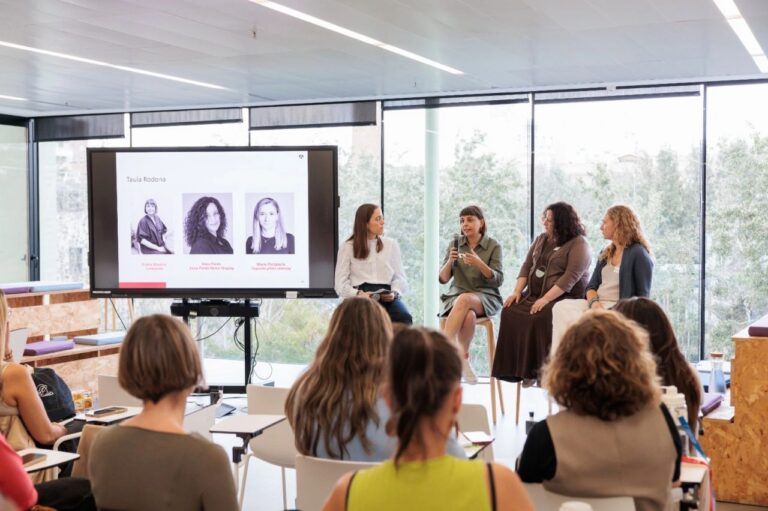
The event combined talks, a panel discussion and a networking session to share knowledge and experiences on the challenges and opportunities facing women in business and professional life. The Women Mentoring Programme held its latest edition with an event dedicated to women’s leadership and professional development. The gathering provided opportunities for participants to learn, reflect
