- Companies where remote work will predominate: in 25% of companies, their teams will work remotely an average of four days a week and will go to the office only for specific and occasional reasons.
- Companies with hybrid models: 65% of companies will encourage their employees to work remotely 2 or 3 days a week and to go to the office to interact with their colleagues and participate in collaborative activities and teamwork processes.
- Companies where in-person work will predominate: in only 10% of companies will in-person work be the majority, allowing a maximum of one day a week of remote work.

The future of remote work
3 November 2021
Work, as we know it, has remained relatively stable for many generations: people commuted daily to the same workplace, on the same schedule, and worked with the same colleagues.
New information and communication technologies have laid the foundations for an unprecedented structural change in the economy and the world of work: this is why we speak of a digital revolution. And the Covid-19 pandemic has only accelerated this change, implementing remote work suddenly and on a widespread basis.
How many of you were able to imagine in 2019 that you could work from home on a recurring and normal basis? According to the study “New ways of working. Reflections on the future of work in Spain” by the Boston Consulting Group, 62% of workers today believe that their job can be done remotely.
It seems clear that the remote work experiment during the pandemic has been a resounding success. On the one hand, workers highly value the advantages that remote work brings them, especially the reduction in commuting time to their workplace and the greater flexibility in scheduling that allows them to improve their work-life balance. On the other hand, companies have seen proof that work still gets done without people in their offices and have discovered the great potential of technologies for individual and collaborative work without the need for physical presence, as well as for reducing structural costs.
But if the result has been so positive, why return to in-person work? On the one hand, many workers state that they miss the social relationships established by going to work, and some declare that they do not have adequate working conditions at home. On the other hand, companies miss physical presence as a driver of organizational identity and culture, as an engine for innovation and often spontaneous collaboration, and as an accelerator for learning and the integration of new hires.
According to the Boston Consulting Group study, 93% of managers are in favor of moving forward with the implementation of a hybrid model that combines office work with remote work, and most companies are already designing strategies for its implementation.
But what is the right combination of in-person work and remote work? The answer depends on many factors: the company’s activity, the functions of each job position, the qualifications of the workers, the quality of labor relations, etc.
According to the study, by 2025 there will be three major work models:
Share
30/09/2026
Once upon a time, there was a country where young people had no opportunities. It was 1986, and in Catalonia many young people were looking for work, but work had a bad habit of hiding. They sent out CVs, knocked on doors… but found them all closed. And if one did open, the answer was
29/09/2026
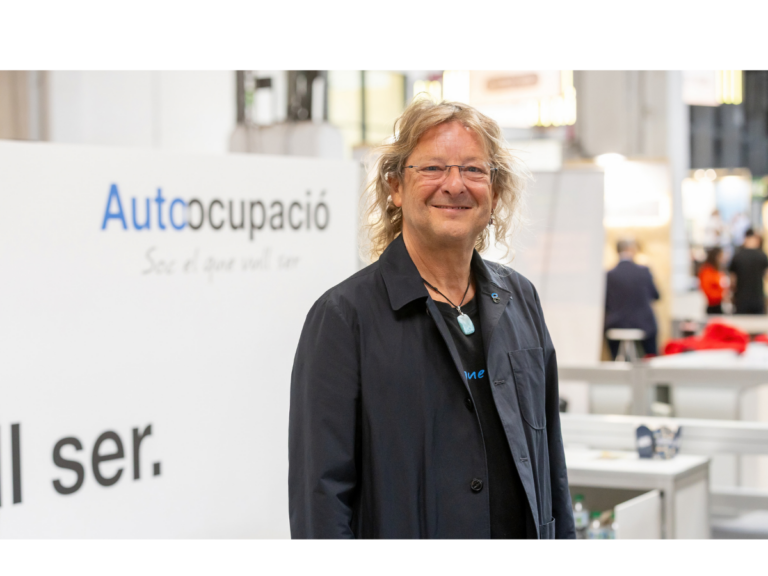
Interview with Albert Colomer i Espinet, President of Autoocupació
1. What do you remember most vividly about the summer of 1986, when what is now Autoocupació began to take shape? What I remember most about that summer of 1986 is the excitement and the conviction that we needed to do something different. It was a difficult time, with youth unemployment approaching 50%. People without

27/08/2026
New grants of up to €5,000 to open, renovate or digitalise businesses in Lleida
Self-employed professionals, micro-enterprises and small businesses with street-level premises in Lleida can apply for grants of up to €5,000 to carry out renovations, improvements or digitalisation projects. The grant covers 50% of eligible expenditure, subject to a minimum investment of €2,000 excluding VAT. The full amount awarded will be paid in advance, with no guarantee

28/07/2026
Youth Guarantee 2026: Up to €17,094 to Launch Your Self-Employment Project
If you are between 18 and 29 years old and want to start your own business, the Youth Guarantee grant can help turn your entrepreneurial project into reality. This financial aid is designed to support young people entering the labour market through self-employment by providing funding for both the start-up of their business and the
