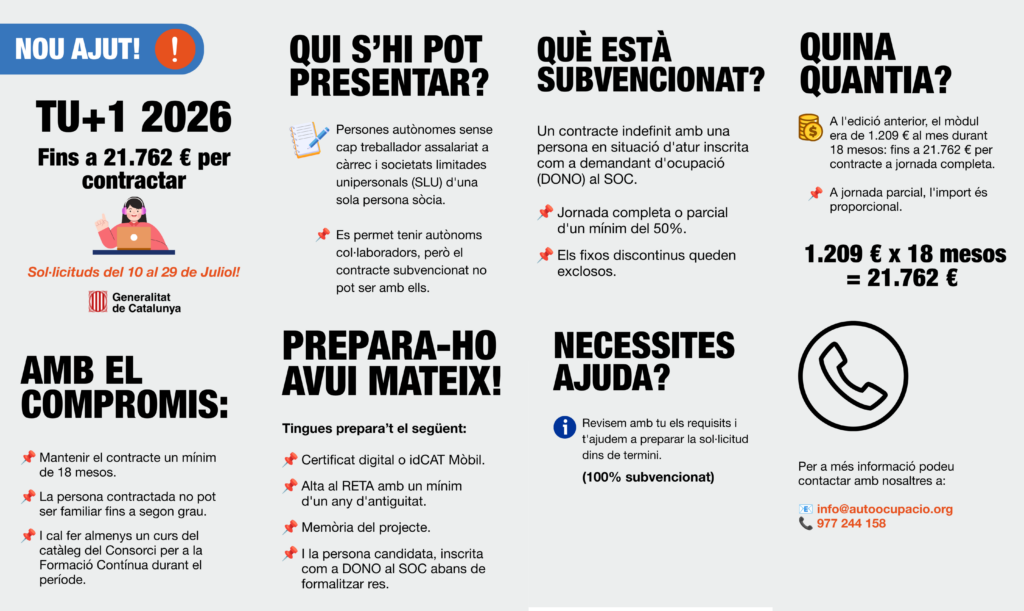
The Government of Catalonia (Generalitat de Catalunya) has launched the 2026 call for applications for the TU+1 Programme, a grant scheme designed to help self-employed professionals and single-member limited liability companies (SLUs) with no employees hire their first worker on a permanent contract.
Applications can be submitted from 9:00 a.m. on July 10, 2026, until 2:00 p.m. on July 29, 2026.
Who can apply?
The grant is available to:
- Self-employed professionals with no employees on their payroll.
- Single-member limited liability companies (SLUs) with a single shareholder and no employees.
Self-employed applicants may have collaborating self-employed family members, but the person hired through this grant cannot be one of them.
What does the programme fund?
The grant supports the permanent hiring of one or two employees who are unemployed and registered with the Public Employment Service of Catalonia (SOC) as Registered Job Seekers (DONO) before the employment contract is signed.
Eligible contracts may be:
- Full-time.
- Part-time, provided they represent at least 50% of the standard working hours.
Permanent seasonal contracts (fixed-discontinuous contracts) are not eligible.
How much funding is available?
For full-time contracts, the grant can provide up to €21,762, based on a monthly module of €1,209 over an 18-month period.
For part-time contracts, the amount is reduced proportionally according to the employee’s working hours.
What commitments must beneficiaries meet?
To retain the grant, beneficiaries must:
- Maintain the employment contract for at least 18 months.
- Ensure that the hired employee is not related to the beneficiary up to the second degree of kinship.
- Complete at least one training course from the catalogue offered by the Consortium for Continuing Training of Catalonia during the implementation period.
What should you prepare before applying?
To speed up the application process, it is recommended to have:
- A digital certificate or idCAT Mòbil.
- Registration with the Special Scheme for Self-Employed Workers (RETA) with a minimum of one year’s seniority.
- The project report.
- A candidate registered with the SOC as a DONO (Registered Job Seeker) before signing the employment contract.
If you need advice to check whether you meet the eligibility requirements or assistance in preparing your application within the deadline, we offer a 100% subsidised advisory service.
Contact us:
Email: info@autoocupacio.org
Phone: +34 977 244 158