Digital transformation processes and the increasing mobility of the labor market are accelerating the pace of changes in the professional profiles demanded by companies. This acceleration means that many technical and professional competencies, those specific skills linked to a particular job, which until recently were the most valued, are no longer a priority.
On the other hand,
the new labor market demands professionals with a high degree of development in transversal competencies, also known as
soft skills, which are abilities useful in any job, company, or sector.
Typically, transversal competencies are classified into three groups:
- Identification: those based on self-awareness and self-regulation, such as self-confidence, time management, adaptability, or resilience.
- Relationship: those based on interaction and collaboration with others, such as communication, leadership, teamwork, empathy, or networking.
- Confrontation: those necessary to face challenges and solve problems, such as critical thinking, creativity, decision-making, or negotiation.
We all possess these competencies: we have acquired them, to a greater or lesser extent, through our personal and professional experience. But how can we measure them? And how can we improve them?
Autoocupació has launched
neoSKILLS, a
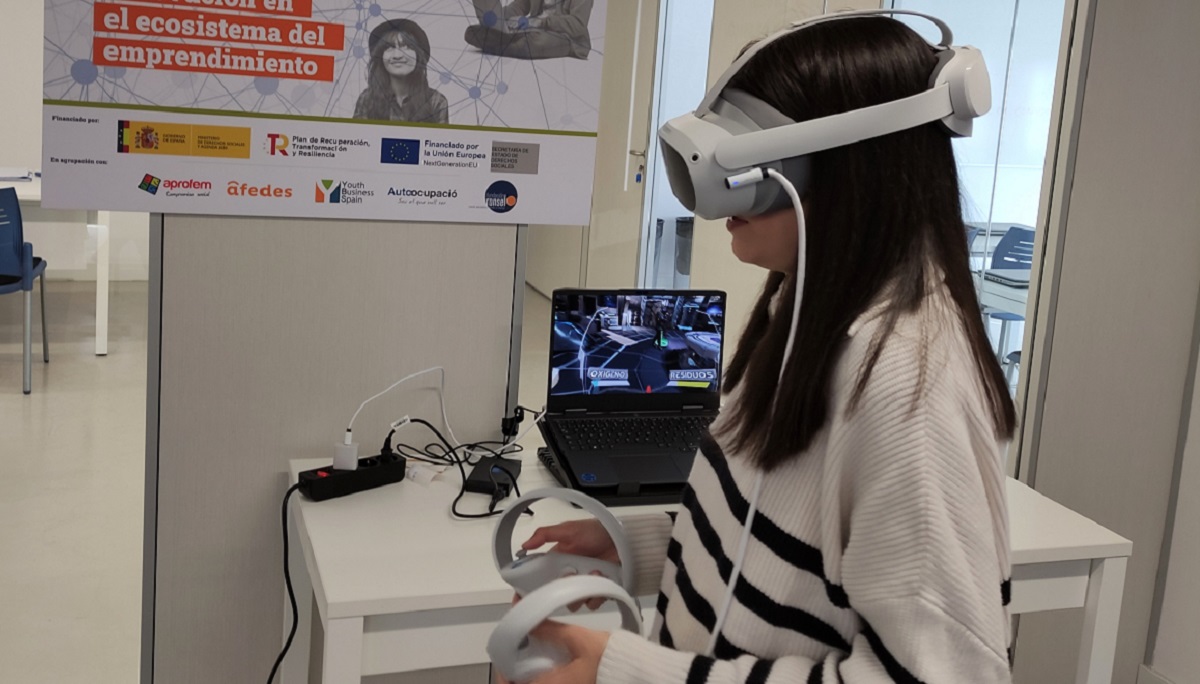
technology that uses virtual reality to diagnose and train these soft skills, helping participants improve their employability.
What is neoSKILLS?
NeoSKILLS is a
hybrid simulator that offers participants the opportunity to immerse themselves in a
virtual reality environment, where they must test their transversal competencies to face a series of challenges, providing them with a gamified, collaborative, and meaningful
experiential learning experience.
The transversal competencies that this innovation helps to diagnose and train are effective communication, adaptability to change, leadership, functional planning, and teamwork.
This experience is designed for
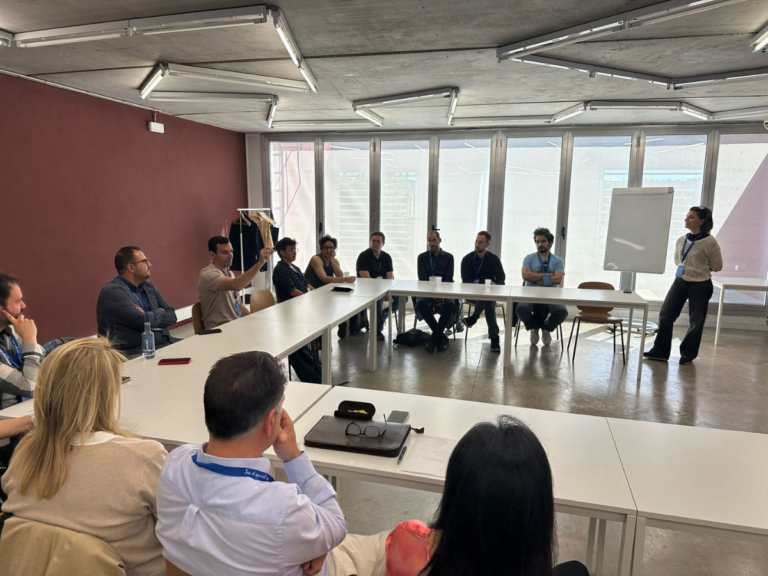
teams of five participants and is facilitated by two people who guide them through the process, evaluating their competency development. The duration of a session is between two and three hours, depending on the performance of each team.
What is the implementation process?
Participation begins with an introduction to the new context, preparing individuals for a virtual reality experience where each participant assumes one or more predetermined roles.
Once the experience begins,
the simulator presents different challenges that the team must address sequentially, while the facilitators monitor the individual and collective behaviors of the participants, evaluating their transversal competencies.
The fact that the experience unfolds in a completely unknown context and with new technology has a major impact on the behavior of participants, both individually and collectively, and on the roles each person assumes at the beginning and exercises throughout the experience.
At the end of the session, the facilitators provide each participant with a self-assessment questionnaire for competencies, a second questionnaire to evaluate the competencies of the rest of the team, and give them
feedback on their individual and collective behavior. Thus,
each participant receives a detailed competency report with a 360-degree view. This report serves as a starting point for designing a personalized training plan for transversal competencies.
The Social Tech Labt2 project
Autoocupació has implemented virtual reality for the training and evaluation of transversal competencies within the framework of its digital transformation process, specifically the
Social Tech Labt2 project, funded by the support program for the modernization of the third sector from the European Recovery, Transformation and Resilience Fund – NextGenerationEU.
This tool is systematically implemented in the various professional guidance programs carried out by the entity, improving the participants’ experience through innovation and gamification, helping them to evaluate and train their
soft skills, to increase their employability and so they can say:
I am what I want to be.